The evidence
Photographs from the survey, exactly as taken.
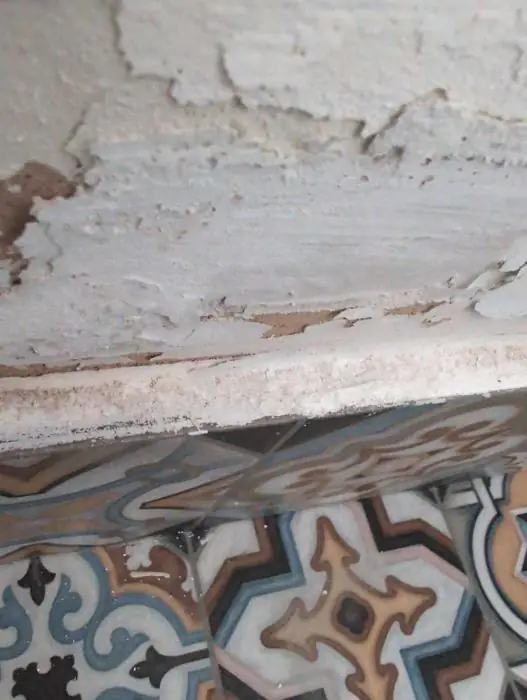
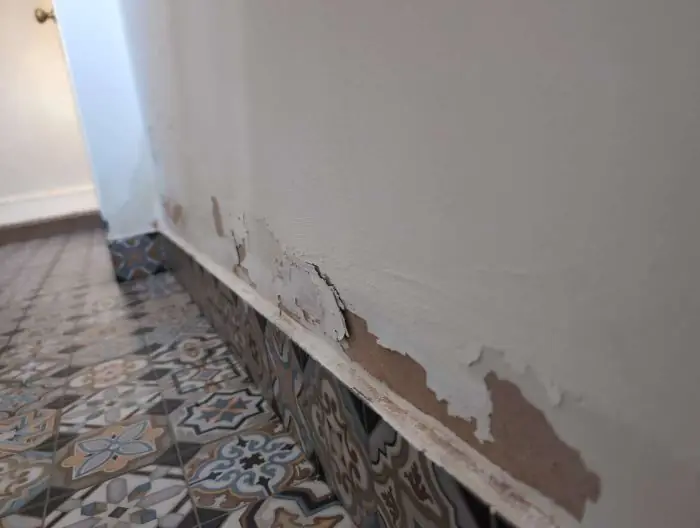
Damage to the plaster and decoration at the base of the walls in a ground floor bathroom, present all year. The owner wanted to know whether it was moisture and salts left from past leaks, or moisture still getting in. The honest answer is: most probably the first, and here is exactly how to rule out the second.
See exactly what you get: read a real Vigilant report, published with the client's permission.
The owner's account, recorded as given: the damage was first noticed some years ago and is present all year, damp to the touch, with staining. There had been an earlier escape of water from the hot water cylinder in this room, and past leaks from the toilet plumbing and an external downpipe, as repaired about two years ago. The heating has been topped up once in the last 12 months, in very small quantities.
We were asked to establish whether the deterioration at the base of the walls is due to moisture and salts left from past leaks, or to moisture that is still getting in, and the work indicated.
A semi detached house of 1850 to 1918, of solid brick, seen, with a solid tiled floor, seen. The bathroom is on the ground floor, with a toilet, a basin, a washing machine and a high level cistern. The house is heated by a gas system boiler.
This was a focused survey of the bathroom. It was a dry day after light rain in the previous two days. No floors or walls were opened up, no external elevations were recorded and no comparison room was measured.
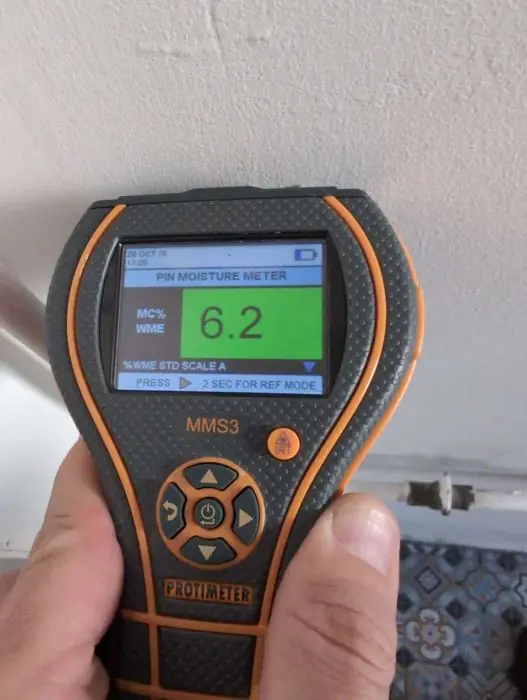
The control, on the internal partition wall, read 6.2 %WME. Then both affected walls were mapped at four heights.
The internal partition wall, which backs onto the kitchen:
| Height | Left | Centre left | Middle | Centre right | Right |
|---|---|---|---|---|---|
| 200mm below ceiling | 7.4 | 6.8 | 7.7 | 8.8 | 9.5 |
| 1200mm | 6.4 | 7.2 | 7.3 | 8.2 | 9.5 |
| 600mm | 7.4 | 8.9 | 8.4 | 9.7 | 11.7 |
| Skirting, 100mm | 100 | 100 | 81.4 | 97.6 | 14.9 |
The external wall:
| Height | Left | Centre | Right |
|---|---|---|---|
| 200mm below ceiling | 9.5 | not reached | 6 |
| 1200mm | 10 | 10.3 | 10.1 |
| 600mm | 19.9 | 25.4 | 18.4 |
| Skirting, 100mm | 40.5 | 52.4 | 46.5 |
Elevated only at the base of both walls, with a sharp fall above. The worst of it is on the internal wall, which has no outside face, at the base opposite the toilet and the former cylinder position. From 600mm upwards every reading on that wall is close to the control.
The floor read high from end to end. It was measured with a pinless meter on its relative scale, which compares one area with another and is not %WME. It gave elevated readings across the whole area tested, from 340 to 999 on that scale.
A meter reads salts and moisture alike, so all of these are elevated readings, not a measure of water content.
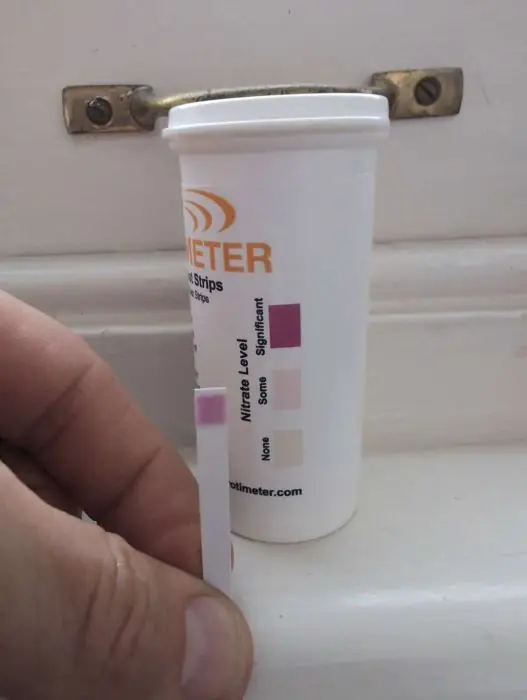
Efflorescence and peeling paint were seen and photographed. A salts analysis of plaster scrapings taken by the toilet found nitrates present and no chlorides.
Read together with the pattern of readings, highest at the base of the internal wall opposite the toilet and the former cylinder position, and with no soil or organic matter against that internal wall, the report assesses this result as consistent with mains water from the toilet flush or the former cylinder rather than ground moisture. The house tap water was not tested with the kit for comparison, and no plaster from the control wall was tested, so the result is read without either comparison.
With a salt present, the plaster is hygroscopic and will keep reading high after the source is dealt with.
Photographs from the survey, exactly as taken.
The pattern of readings, elevated at the base of both walls and across the floor and falling sharply above, is most consistent with moisture held beneath the floor tiles from a past escape of water being drawn into the base of the walls, with salts in the plaster keeping the readings high.
Because the heating has needed topping up and the toilet waste could not be inspected, a continuing leak cannot be excluded. That is why the plumbing and heating are checked first.
A damp proof course is not indicated.
First, test the toilet. A plumber can water test the toilet branch and pan connector from the access cap on the external soil pipe, about 1m from the pan connector, and flush test at the flush pipe cone, without opening the boxing. Open the boxing only if the waste side fails. Then pressure test the heating and the former cylinder pipework, repair any leak found, and let the area dry. We identify the likely source. We do not open up floors or walls to find it.
Then drilled samples from the base of the internal wall and the external wall, tested for moisture content and salts against a sample from the dry control wall. These show how much moisture remains and whether it is still arriving.
Inspect beneath the floor tiles, by opening up or with a borescope, with the owner's consent.
Brush the salt deposits off dry. Do not wash them off. Washing puts water back into the wall and carries the salts back in with it.
Improve ventilation: a trickle vent or a wall vent, a clear gap under the door, and an extract fan ducted to outside. The room has a toilet, basin and washing machine and no mechanical extract.
Only once the source is stopped and the wall has had a drying period, remove the salt contaminated plaster back to the masonry, beyond the last visible sign of salts and to 1.2m, or 300mm above the affected area, whichever is greater, and replaster with a salt resistant renovating plaster. On a solid wall, a breathable system such as one based on natural hydraulic lime, so the wall can keep drying outward.
Never replaster in gypsum, which draws the salts in and breaks down. Do not apply any waterproof paint, sealer or water repellent while salts are still coming out: it traps them behind the surface, where they crystallise and make spalling worse. Do not redecorate before the walls have dried and been measured again.
The report records this as requires further investigation, not as highly probable, because a continuing leak has not been ruled out. What would settle it: a pressure test of the heating and hot water, and the water test of the toilet waste, to show whether any leak is still running. Then drilled samples from the base of both walls, against a sample from the dry control wall, to separate moisture from salts and show whether moisture is still reaching the walls. A tap water baseline with the salts kit, and readings and floor levels on the kitchen side of the shared wall, would close the rest.
Fixed fee from £350. We carry out no remedial work, sell no products, and take no commission or referral fee from anyone who carries out repairs.
Request a call back How we survey